April 20, 2026 - ALOHA MONDAY!
I recently stepped away for a brief hiatus to dive into new client partnerships and a personal passion project, but you were never far from my mind. This topic is your golden ticket, if you’re ready to accept the mission.
Buckle up; we’ve curated a high-impact mentor lab video for you. Plus, keep an eye out for a follow-up explainer on Ikujiro Nonaka’s SECI model, where we’ll explore how a Community of Practice can help you shatter the technology silo and evolve into a true Strategic Integrator.
If you are the go-to technical expert in your architecture, engineering, or construction firm, you might be trapped in a high-tech cage without even knowing it. We call it the "Revit Hermit" trap.
Beyond the Clicks: How to Stop Being a "Software Wizard" and Start Modeling the Future
You live inside the model, speak fluently in keyboard shortcuts, and are convinced that mastering just one more plugin is your golden ticket to a seat at the leadership table. But here is the hard truth: mastering software is not the same as leading a strategy. Technology, whether it’s BIM, VR, or AI, is just a vehicle. Real innovation is a human-centric approach to solving problems and improving life.
Question: Do you feel you may fall into the ‘Revit Hermit’ category? If so, no worries brah, we are going to change that right about now!
To get UNSTUCK, you must evolve from a technology technician into an Operational Integrator.
The Secret of the Lunch Break: Tacit vs. Explicit Knowledge
The key to this evolution lies in a secret you won't find in any software manual: Tacit Knowledge. To understand this, look away from your computer screen and imagine a plumbing crew on a construction site during lunch break.
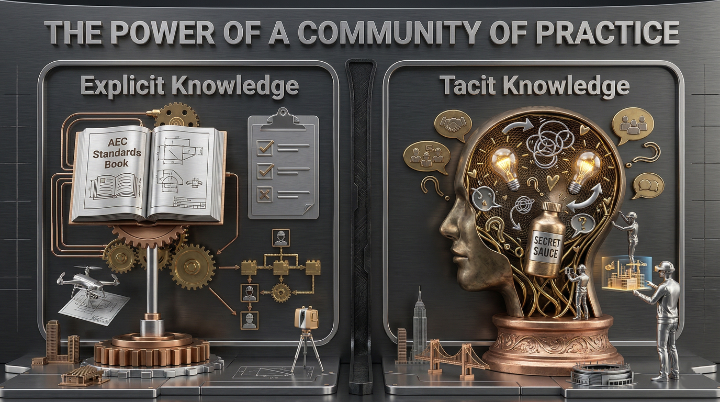
In the world of knowledge management, there are two types of information:
-
Explicit Knowledge: The "what." This is the stuff we can write down, BIM execution plans, SOP’s, and project reports.
-
Tacit Knowledge: The "how." This is the intuition, the "gut feeling," and the trade secrets learned through years of hands-on experience.
True innovation happens in the SECI Spiral (Ikujiro Nonaka), the continuous dance of capturing messy, intuitive tacit knowledge and encoding it into structured, explicit standards that an entire organization can use. Stay tuned as next week, I'll dive deeper into the SECI spiral.
Building the "Ba": Your Engine for Innovation
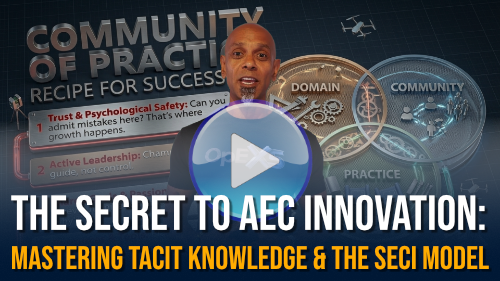
You cannot force this transformation with a corporate memo or a mandatory meeting. Instead, you must build a "Ba" (as Nonaka calls it): a shared space or community of practice (CoP) built on trust, psychological safety, and the exchange of stories.
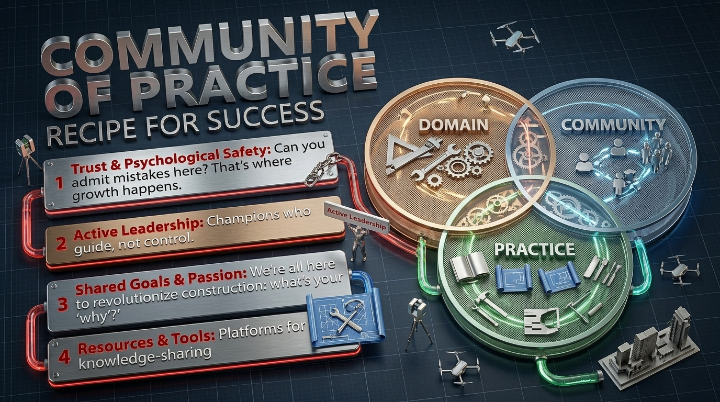
A successful Community of Practice has three essential ingredients:
-
The Domain: The shared business problem you genuinely care about solving (e.g., "How do we stop wasting time on field fixes?").
-
The Community: Relationships where people feel safe enough to ask "dumb" questions and admit mistakes.
-
The Practice: Your shared toolkit of "war stories," visual guides, and hard-won lessons.