October 19, 2026 - ALOHA MONDAY!
Welcome back to another edition of the AEC UNSTUCK newsletter!
If you want to measure the strength of your Virtual Design and Construction (VDC) program, stop counting software licenses and stop bragging about the size of your VDC department.
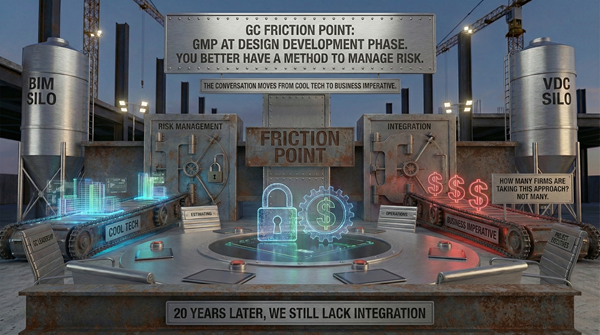
For over two decades, the AEC industry has poured fortunes into Building Information Modeling (BIM) and VDC, attempting to fix an annual $15.8 billion operational leak caused by disconnected systems, process silos, and bad data.
Yet, when executive leadership evaluates digital maturity, they instinctively default to vanity metrics:
- How many VDC specialists have we hired?
- How many cloud seats did we deploy?
- How many clash detection reports did we run?
Those are investments, not outcomes. Software licenses measure corporate spending, not jobsite adoption.
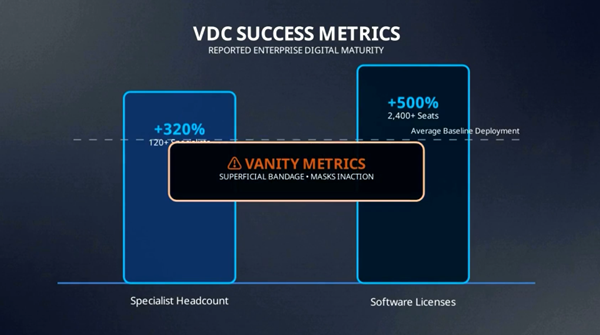
The reality across the construction industry is blunt: We do not have a technology problem in AEC; we have a leadership accountability problem.
Without executive leadership holding every project role accountable for leveraging digital tools and field technology, firms will never achieve authentic digital transformation or future-proof their business.
The 20-Year Paradox: Trapped in the Specialist Silo
The biggest lie of the last 20 years is that technology alone transforms project delivery.
Many general contractors have built VDC departments with dozens, sometimes over 100, team members. Yet on jobsites nationwide, project delivery remains choked by the exact same bottlenecks. Why? Because the industry relegated digital delivery to isolated technical specialists, the "double clickers" and modelers who sit in trailers or corporate offices disconnected from daily operations.
VDC technicians and BIM specialists do not sign trade contracts, approve payment applications, or make critical commercial and field decisions. Traditional operational project roles do.
Recent experience observed on a multi-billion-dollar project:
During a 30-minute coordination meeting, a trade contractor's VDC lead was interrupted twice by field leadership, a Project Engineer and a Superintendent, asking the technician to look up basic dimensional and embed data in the 3D model. Both field leaders had laptops and mobile devices with immediate model access.
When asked why they didn’t open the model themselves, their response was simple: walking over to the VDC desk and asking someone else to do it was faster.
That is not a technology failure, and it is not field resistance. It is an enablement and accountability vacuum. When traditional roles are not trained or required to touch digital tools, BIM becomes nothing more than "BINO": BIM In Name Only, or Hollywood BIM: a pretty picture used in owner pursuit interviews that provides zero actionable value to the superintendent pouring concrete.
The Approaching Double Crisis
(and the AI Illusion)
Leaving technology in a silo is no longer just inefficient, it is an existential risk to your firm’s survival. The construction industry is heading straight into a generational pinch point:
-
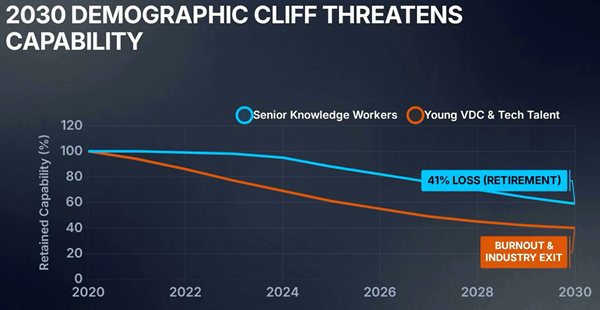
The 2030 Demographic Cliff: By 2030, an estimated 41% of senior field leadership and project management will retire, taking roughly 500,000 experienced professionals and decades of unwritten, tacit knowledge out the door.
-
Early-Career Talent Burnout: Early-career digital talent enters the industry eager to build, only to be reduced to "human search engines", spending their days taking screenshots and pulling dimensions for project managers who refuse to open a model. Frustrated and burnt out, this young talent is walking away from construction for tech and consulting firms.
When field wisdom exits from the top and technical talent drains out from the bottom, firms operating in silos will face an operational deficit from which they cannot recover.
Meanwhile, leadership teams are rushing to pour capital into enterprise AI platforms, predictive data lakes, and flashy machine learning tools. But if your project managers and superintendents are still managing core RFIs, submittals, and trade coordination through disconnected, fragile Excel spreadsheets, AI will not save you. Chasing AI without establishing foundational jobsite digital literacy will merely repeat the exact same 20-year adoption failure that crippled BIM.
Back to the Basics: BIM is the Noun, VDC is the Verb
To fix this, leadership must get back to basics and reclaim foundational definitions:
-
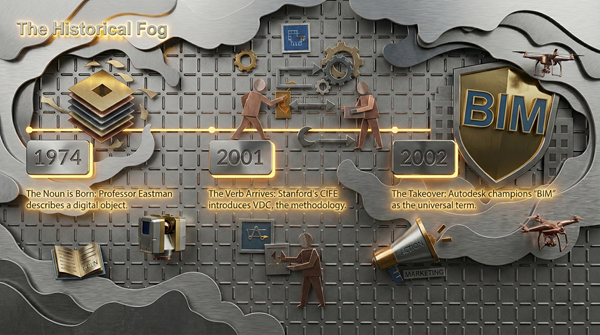
BIM is the Noun: The digital geometry, building description system, spatial metadata, and coordinated 3D models.
-
VDC is the Verb: The operational execution, visual communication, and integrated processes used by people to make earlier, better-informed business and field decisions.
Technology has only three core purposes: to visualize the work to improve communication, to enhance collaboration among project stakeholders, and to drive faster, better-informed decisions.
True digital transformation does not belong to the technologist; it belongs to the enterprise. It requires investing in human capital and developing everyday talent to meet the escalating demands of modern project delivery.
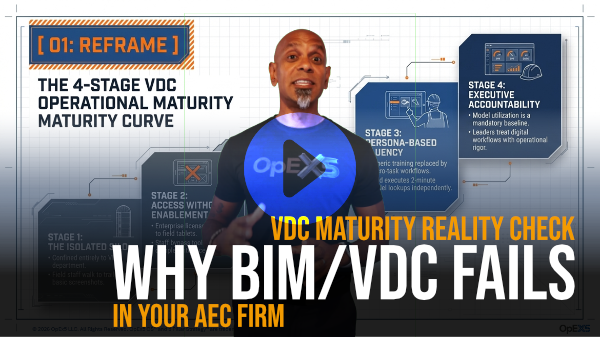
Mentor Lab Video Explainer
To see the breakdown of how these operational dynamics play out on live jobsites, and how forward-thinking firms are breaking out of the technician silo, watch the full video companion to this article:
The Strategic Blueprint: Two Shifts Leadership Must Mandate
If an executive team can rally an entire enterprise around a physical safety mandate or a new mechanical field tool, they can apply that same operational rigor to digital workflows. Scaling digital fluency requires two intentional shifts: